It's been quite some time, I know, and I fully intend to enlighten you as to my whereabouts, my doings, and my hullabaloos. Since I last posted, the parents have visited France (Howdy!), I've rung in the New Year with a fair bit of champagne, I've been to England, and I've seen a naked French man onstage. (It was theater, people. Nothing more.)
I don't have time for a full update at the moment, largely because it's 1 a.m., and I'm due in bed. I start teaching on Monday, so tomorrow will be filled with the joy of writing a mini-lecture and getting my class materials together. It's been hectic here, what with the teaching prep, working on a paper for a workshop, and taking care of all of the enrollment business for French classes (which will be two nights a week, starting the week after next). Yesiree, busy indeed. But more on that later.
For now, I will just say that in France, I tend to get two types of mail:
1) Useful Numbers sheets: At least once per day, I get a sheet of telephone numbers telling me how to reach emergency plumbers, hospitals, police, laundresses, tofu-grillers, and banister-shiners. All very useful. And they (whoever this nameless, faceless "they" is/are) feel the need to tell me precisely how useful repeatedly. I guess if I need those numbers, I can rest assured that I can go to my mailbox, and there will be a new reminder. But what if I have an emergency lost-postbox-key? What then, useful numbers?
2) Pamphlets for local sushi restaurants: I have no idea how many of them there are, but it's starting to seem like a lot, and they all have names like "Club Generation Sushi" and "Neon Space Sushi Club." And only in France will you get a "California Foie Gras Roll" and a "Goat-Cheese Chive Maki." I love sushi, but I'm very afraid.
If I one day wake up, and all the useful numbers are for take-away sushi joints, my head might just explode. But Tyson will know where to go to have it emergency-replaced with a cooked tuna maki wrapped with scrambled-egg. (Yes. I kid not.)
Thursday, January 28, 2010

Thursday, December 10, 2009
The French don't play around, it seems.
I can tell that Christmas is drawing near since my corner grocery store (not a fancy place, mind you) is filled with the most decadent meats possible. On one shelf, and one shelf alone, I spotted foie gras, gésiers, magret, boudin, rilletes, terrine, and paté.
Wednesday, December 2, 2009
Happy holidays!
Number one: My bank account is up, running, and functional. I have checks. I have a card. I have a working online banking set up. In short, I have triumphed. Now it's on to getting a subscription metro card and perhaps a monthly movie pass. It may be a few days late, but I know what I'm thankful for this Thanksgiving.
Which speaking of, Tyson and I passed the holiday in pleasantness, but without any of the traditional trappings. We had a workshop at the Paris Center that day, and two of our friends also have seminars, so we ended up ditching the turkey and pie and stuffing and casseroles in the name of very hearty Vietnamese food. We lived up to the expectation that one becomes so stuffed on Thanksgiving that it's impossible to move, but it wasn't quite the same. But we did have a few other friends who had family visiting for the holiday, and they tried to put together the traditional American experience. First, it seems that few Parisian butchers stock whole turkeys. Ask for pig ears or whole rabbits, and you will come out well-served. But a full turkey? Not unless you special order it. So our friends decided to do just that, having finally found a butcher that would oblige. Except he then offered them a "dinde americaine" (American turkey) weighing somewhere in the arena of 16 kg (roughly 32 pounds). Our friends politely declined and asked for a "dinde française" which ended up coming in somewhere around 4 kg. I guess it's true that Americans do everything bigger.
Another roadblock to an American Thanksgiving would be the paucity of cranberries. Somehow, these little rosy gems haven't made it over here as a usual fruit. And don't even think about canned pumpkin. Of course, at the market you can approach a stand with a massive, probably-16-kg pumpkin (it must be a "potiron americain") and ask them to hack you off a slice. So pumpkin isn't unavailable, but don't look for Libby's.
That said, there are a few import stores here, one of which is called, aptly enough "Thanksgiving." Another one, whose name I forget, specializes in Cajun goods, for some reason, so I guess I know where to go to get my Tony Chachere's. I have not visited these stores, mostly because I'm sure their prices are marked sky-high, but perhaps there is hope for an American Thanksgiving in Paris.
And if you happen to need mushrooms for a particular casserole or other dish, France does have a lovely option for you. If you pick your own, and you're unsure of whether eating those lovelies will kill you, take them to any pharmacy. The pharmacists here are required by law, apparently, to be trained in mycology. I love the idea of toting in a huge basket filled with mushrooms and being told whether they are safe by a white-coated official who can also provide your ibuprofen and cough drops (all available only in an actual pharmacy). What a country!
Which speaking of, Tyson and I passed the holiday in pleasantness, but without any of the traditional trappings. We had a workshop at the Paris Center that day, and two of our friends also have seminars, so we ended up ditching the turkey and pie and stuffing and casseroles in the name of very hearty Vietnamese food. We lived up to the expectation that one becomes so stuffed on Thanksgiving that it's impossible to move, but it wasn't quite the same. But we did have a few other friends who had family visiting for the holiday, and they tried to put together the traditional American experience. First, it seems that few Parisian butchers stock whole turkeys. Ask for pig ears or whole rabbits, and you will come out well-served. But a full turkey? Not unless you special order it. So our friends decided to do just that, having finally found a butcher that would oblige. Except he then offered them a "dinde americaine" (American turkey) weighing somewhere in the arena of 16 kg (roughly 32 pounds). Our friends politely declined and asked for a "dinde française" which ended up coming in somewhere around 4 kg. I guess it's true that Americans do everything bigger.
Another roadblock to an American Thanksgiving would be the paucity of cranberries. Somehow, these little rosy gems haven't made it over here as a usual fruit. And don't even think about canned pumpkin. Of course, at the market you can approach a stand with a massive, probably-16-kg pumpkin (it must be a "potiron americain") and ask them to hack you off a slice. So pumpkin isn't unavailable, but don't look for Libby's.
That said, there are a few import stores here, one of which is called, aptly enough "Thanksgiving." Another one, whose name I forget, specializes in Cajun goods, for some reason, so I guess I know where to go to get my Tony Chachere's. I have not visited these stores, mostly because I'm sure their prices are marked sky-high, but perhaps there is hope for an American Thanksgiving in Paris.
And if you happen to need mushrooms for a particular casserole or other dish, France does have a lovely option for you. If you pick your own, and you're unsure of whether eating those lovelies will kill you, take them to any pharmacy. The pharmacists here are required by law, apparently, to be trained in mycology. I love the idea of toting in a huge basket filled with mushrooms and being told whether they are safe by a white-coated official who can also provide your ibuprofen and cough drops (all available only in an actual pharmacy). What a country!
Saturday, November 14, 2009
Learning to Embrace Oddity
 There are many things that I don't understand about this painting (Le Singe peintre by the masterful, if strange Jean-Baptiste Deshays). Woman's hair, slightly mannish physique. Cloth tornado. Monkey. Who is a painter. And a knight (I know because he's carrying a sword). Who paints from a strange vantage.
And yet, I find it compelling. I like his skinny little tail and his placid, calm look. I would like to think that 18th-century monkeys were trained in the beaux arts and operated according to a patronage system. Perhaps Fragonard and David and Greuze all farmed their work out to monkeys. And it's a painting like this, which is in the Musée des Beaux Arts in Rouen, that teach me that sometimes weirdness can be compelling. And while I haven't quite experienced anything so weird as a painting monkey here in Paris, I've recently had a few odd experiences that I thought worth sharing. Even though Paris often feels comfortable and homey to me, I must constantly remind myself that it is, at its heart, foreign to me. And when this rings true, I love it even more.
Food is the ultimate in bringing people together:
Tyson and I were walking home from the Bibliothèque nationale de France one day, and decided to visit a nearby fast food stand that sells crêpes and gaufres (waffles). We hadn't eaten lunch, and the sugar and butter smelled too good to resist, so we stopped by and ordered gaufres topped with powdered sugar. The man behind the counter slowly poured the batter into the mold, tended to the orders of a few other customers, and then handed us the hot waffles in thin paper containers. Treats in hand, we proceeded on our walk home, consuming them quickly and letting the sugar drop onto our clothes (black, of course, like all Parisian attire). After about a minute, we saw a jogger coming towards us. He drew nearer and nearer. We stepped aside a bit to let him pass. He was very near to us, but seemed to be paying us no mind. Except, at the last minute, when he was even with us on the sidewalk, he called, "Bon appetit!" never slowing or missing a beat. You know you're in Paris when wishing the joy of food on others is so much like a compulsion that an out-of-breath stranger feels the need to tell you to enjoy your fast food.
Alcohol is never out of place:
It's Sunday. And your church is having a bake sale. The church is on a large road that runs through a busy part of the city. It's about 3 p.m. Children are there, running and playing games near the entryway of the church (which is huge and magnificent and dates back quite a ways, as one can tell from the carved figures on its façade). Mothers are laughing, old women are sitting in folding chairs under the tent. There are madeleines and cannelles and all sorts of molleux. It's a garden of sugary sweets. And of course, one cannot consume sweets without something to drink.
It's true that Parisians rarely drink water. (And it is considered impolite to ask to use someone's bathroom in their home. The two are certainly correlated.) So water is out of the question. Sodas? Expensive and not often consumed. Wine? Maybe it's too close to the blood of Christ. I don't know. But what I do know is: the church bake sale was offering huge plastic cups of port for €1.50. Way to go, France. And way to go, church!
The French have mastered the art of being definitive:
I was walking along the street one day and caught the tail end of a conversation between two men. One had asked a question, and the other one, seeming very engaged, gesticulating broadly, answered, finishing with "parce que voilà" (which roughly translates to something like, "because that's it") in a very definitive way, as if the conversation were now completely and totally finished, as if there were no possible way that the first man could have a response. It's the verbal equivalent of what I like to affectionately refer to as the Gallic shrug, which is a usually lackadaisical gesture, a slow raising of the shoulders and a slight tilt of the head that implies, "you're SOL." Sometimes there's a little purse of the lips that accompanies it, and if you're really lucky, sometimes even a little spurt of air that comes out of the pursed lips for emphasis. Often the Gallic shrug will be followed by the phrase, "C'est pas possible" ("It's not possible."). And it always means, "end of conversation."
So imagine:
"I need to call up this set of papers."
"Why?"
"Because I need to use them for research."
"Why?"
"Because they would be helpful."
"Well..." *Gallic shrug* "I am sorry, but it's not possible."
"What do you mean it's not possible?"
"It's just not possible. Those papers are indisposed."
"Why?"
"Parce que voilà."
To which I would reply, "La vache!"
Yes, that's right, "the cow!" is an expression of surprise. It's the equivalent of "Oh my God." But don't say that in Paris. "Gode" can be short for the word "godemiché" ("dildo") in French, so they may very well giggle when you talk about yours in public.
Monday, November 9, 2009
Anger.
Kindergarten tactics are apparently the new mode in politics. And debates aren't supposed to have multiple sides, it seems.
Ick.
Friday, November 6, 2009
The man with the magnificent dancing calves
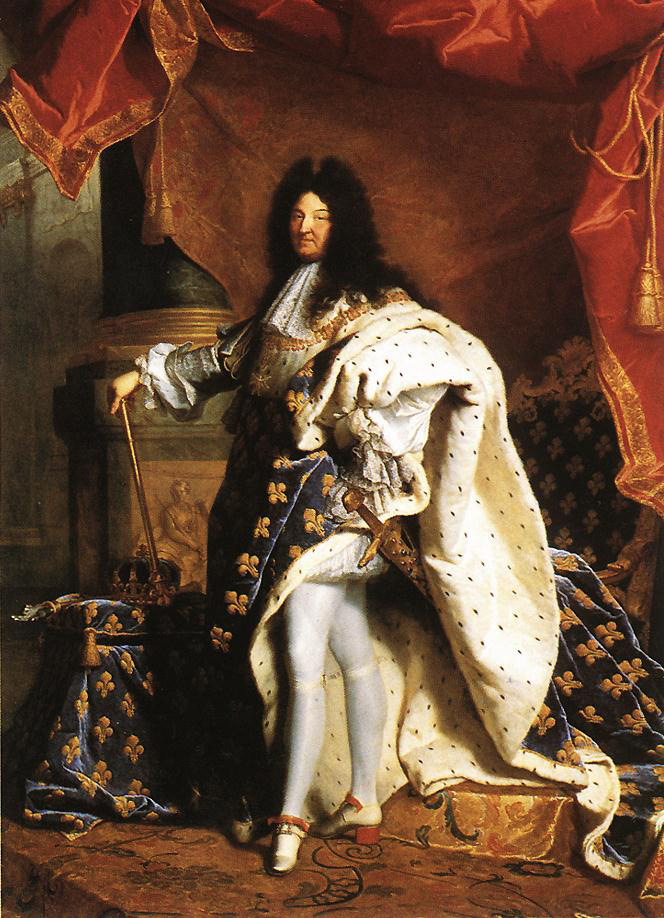 There must be some strange microfauna in the Parisian air because I was sick once again this last week. I spent a few days in bed, and I still have a pretty hacking cough, which I'm sure thrills the souls of all who have had the chance to talk to me. But while I've had a bit of down time, I've been reading Joan DeJean's The Essence of Style: How the French Invented High Fashion, Fine Food, Chic Cafés, Style, Sophistication and Glamour, which focuses on the reign of Louis XIV and how many of our standards of luxury were consciously developed as a response to mercantilist and absolutist ideologies at the time. The book is slim on argument (it must have been designed in inverse ratio to the length of the title)--often frustratingly so--but it is filled with fascinating tidbits, some of which I thought I'd share with you. I knew that Louis XIV really knew how to put on a party and construct an image, but wow. Simply wow.
- Last night I was reading the chapter on diamonds, which it turns out, weren't popular until L14's reign. Pearls had been the previously dominant jewel. But L14 invested a ton of money in expeditions returning from India, and within 30 years, they had already exhausted all of India's mines.
- By the time of his death, Louis had amassed close to 6,000 diamonds, none of which were tiny (meaning less than 5 carats, it seems). After being told by a Turkish ambassador that the horses in Turkey wore more jewels than he did, L14 wore a suit to a court function (at which that same ambassador was present) that was covered in diamonds--over 1,500 carats of them.
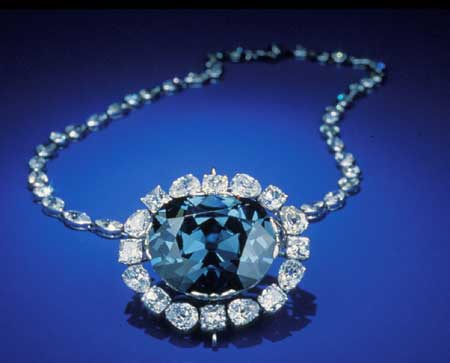
- And his prize gem was called the Blue Diamond of the French crown, which was 111 carats (trimmed down to 69 carats after it was faceted to make it shinier (also a trend started by L14)). He wore it on a ribbon around his neck, and it was part of the crown jewels until the Revolution when it was stolen. It resurfaced, having been cut down to a 45-carat oval, which is now known as the Hope Diamond (below).
- Mirrors, which we all know line the famous hall in Versailles, were a newfangled luxury. But I never realized just how much of one.... The largest mirror that had been documented before L14's reign was 28 inches by 28 inches, and it was considered to be a wonder, with people who would come from all over to see it. (Notably, it belonged to Fouquet, a guy who L14 had tamped down since his splendor was too great. Also, Fouquet's chef committed suicide the night of the king's visit because he thought the shellfish weren't going to arrive.) The mirrors in Versailles are 9 feet tall. Crazy. And in the mid 1660s, the king was spending upwards of $1 million per year on mirrors.

- The king's favorite cocktail, the rossoly: fennel, anise, coriander, dill, and caraway, mascerated in the sun, plus brandy. I want to try the popular ladies' drink, "Venus's oil," which consists of cinnamon water, carnation water, vanilla, sugar, and distilled brandy or wine spirits.
Monday, October 26, 2009
This is why I grumble about graduate school
In the history department, there is a student newslist. People can post upcoming events, articles of interest, job postings, fellowships, etc. Often, people manifest their most pedantic side on this list, I have found over the last few years. There was the great T-shirt crisis of 2008 (who knew that the proposal of a department T-shirt could spark so much controversy?), the issue of the Olympics, and now, the issue of banks. Unsurprisingly, all of these things come back to capitalism and Marx. And while I like Marx a lot (a whole lot, actually), I'm sick of people using him to dichotomize theory and practice. As Tyson has said to me, "Have they ever read the Theses on Feuerbach?" And even when I ideologically agree with the writers of these posts, why can people not keep their mouths shut in improper forums? So, with no further ado, I invite you to the petty debates that plague what is meant to be a list for social organization. NOTE: Don't read on if you get bored with or pissed off at arguments that should remain unargued.
First email:
First email:
Protest the American Bankers Association
October 27 Tuesday

Even though bank deregulation and financial speculation
plunged the economy into its worst crisis since the
Depression, attempts to impose real regulation are being
gutted by the banking lobby as we speak. Even though we threw
trillions of dollars at the banks to save them, they’re still
foreclosing on people, they’re still gouging consumers in a
thousand different ways, and now they’re handing out billions
of dollars in bonuses for new speculative trading even as
unemployment rises.

The economic crisis is a huge opportunity for progressive
change, but instead debate has been dominated by “tea parties”
and unproductive blanket condemnations of the government. This
protest is our best chance – maybe our last chance – to focus
attention on the real problems. Join thousands from Chicago
and around the nation in what should be the biggest protest in
Chicago in years.

Buses will return to campus by 1pm, but if you need to leave
earlier CTA will by happy to oblige.

Endorsed by: Action Now, AFL-CIO, Albany Park Neighborhood
Council, Americans for Financial Reform, ARISE Chicago,
Brighton Park Neighborhood Council, Change To Win, Chicago
Coalition of the Homeless, Citizen Action, Grassroots
Collaborative, Housing Action Illinois, Illinois Alliance for
Retired Americans, Illinois Hunger Coalition, Jane Addams
Senior Caucus, Jobs with Justice, Northside Action and
Justice, Northside POWER, National People's Action, SEIU
Illinois State Council, Southsiders Organized for Unity and
Liberation, UE, Workers United

Second Email:

"This protest is our best chance – maybe our last chance – to focus
attention on the real problems."
Are banks actually the real problem? Is speculation?
Marx argued that the first place that a crisis appears-- in this case the banks involved in real estate-- in actuality was the *last* place it existed and that speculation is a symptom of an *already existing crisis.* In other words, a banking crisis is a fetish form, it misrecognizes that the fundamental problem lies in production and in the relationship between the new value added into the system aka "living labor" and the organic composition of capital. This may well be the best chance for the left to bring to consciousness the "real problems" but the real problems are not problems of finance.
Third Email:
Third Email:
"Did Marx know what a "derivative" was?"

Fourth Email:

"Did Marx know what a "derivative" was?"

I assume that this was meant to be snide, but I also assume
that all people posting to this site are historians, so I may
be wrong on one account, or both. Insofar as we are mostly
historians, we should probably realize that while names change
and "derivatives" become more complex, the idea of futures,
options, and speculative investment did not originate in 2008.

In fact, as anyone familiar with the history of "modern" trade
knows, stock futures began trading in the early 1600s with the
rise of the East India Company. And while the process has
undeniably gotten far more complex in the recent past, the
basic tendency to invest (when the bubble is growing) or
"speculate" (after the bubble has popped) in these options has
been around for centuries.

As has the critique of "speculative practices," "speculation,"
and "speculators." Go read Daniel Defoe, Adam Smith, Charles
Fourier, or a host of other writers who considered the
recurrent crises that have accompanied the modern capitalist
era. They all have interesting things to say about
"speculation." And they all have interesting things to say
about stock-jobbers, cheats, profligates, swindlers, and the
like. Much of it (with the exception of Smith), carries a
distinct anti-Semitic bent.

I think xxx's point is that we can continue the line of
simply protesting the phenomena of the crisis at its most
apparent level (with signs, if necessary), and take up and
continue the critique of contemporary swindlers,
stock-jobbers, and the like. Or we can begin to ask ourselves
why these crises replicate themselves with ever greater
intensity in the modern era.

And to get to that question, you probably should crack open
that Marx and see for yourself what he has to say on the subject.

Just my 4.5 cents o the subject matter. Inflationary pressure
makes words more expensive.


Fifth email:

"Insofar as we are historians," we actually ought to
historicize "futures" instead of assuming an underlying
transhistorical constant. The changing complexity and form of
finance is very relevant to understanding the historical
particularity of types of domination in capitalism.

Also, a more nuanced understanding of Capital is that it
doesn't make sense to dichotomize between a "real" economy and
a "speculative" economy. The forms of domination under
capitalism are characterized by an intricate connection
between finance and production/labor. Of course, you might
also take a look at Moishe Postone's work for a discussion of
how domination in capitalism is abstract, i.e. the fetish is
the real.

The logic behind protesting banks' role in the economic crisis
is precisely to draw attention to the heart of capitalism, the
enablers, the institutions that allow for the increasing size
and sophistication of domination in all spheres of capitalism.


And I guarantee you that the debate is not yet finished.
Subscribe to:
Posts (Atom)